Thursday, 12 September 2019

A Brief Explanation Of Trigger Points In Auto Accident Victims

A Brief Explanation Of Trigger Points In Auto Accident Victims:
Relief of Trigger Points

Trigger Point Injections

Many Car Accident Victims Endure Pain And Physical Issues.

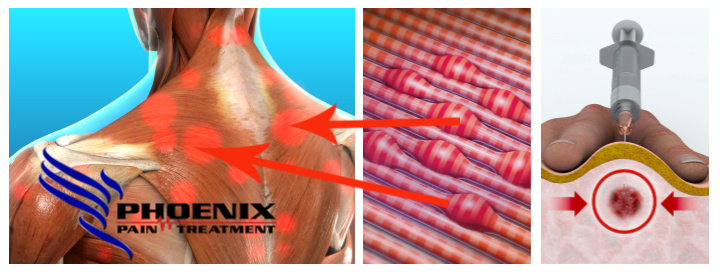
At Phoenix Pain Treatment our clinicians specifically examine for trigger points which can cause pain and suffering. In this article we hope to shine some light on how actively treating your trigger points will decrease your pain, allowing the affected muscles to relax and help to heal your injuries. A trigger point is a small but highly concentrated muscle spasm which can actually be felt as a small lump or nodule. Pushing on this nodule typically produces pain that can be quite intense. Trigger points can exist in any muscle in your body. More often than not there will be several trigger points in the same muscle or muscles that over lap one another.

Whiplash and Trigger Points

Typically following auto accident trauma, especially whiplash injury trigger points can be found on both sides of your body. In the case of whiplash, they can be found in the neck muscles as well as the muscles that connect to the neck from the shoulders. Trigger point cause your muscles to fire and spasm and a muscle that is in spasm is in a weakened state and therefore is not functioning properly. Restricting the muscles range of motion. Trigger point typically cause pain but sometimes are not painful until pressed on. Trigger point pain will refer to different area of your muscles. This is called referred pain and referred pain can make diagnosing and managing trigger points difficult. Referred pain typically follows certain patterns that are well documented. Let’s take a closer look at the trigger point. The trigger points can be palpated by the trained physician, but you have to know what you are looking for in order to find it. That is why we place trigger points in the “Underlying or hidden Injuries” category.

To understand how these seemingly tiny nodules can affect the entire functional capacity of your muscles we have to discuss some anatomy. So think of a muscle as a group of bundles of straws and each straw is wrapped in plastic cling wrap. Then take 2 or 3 or those individual straws and wrap them in plastic wrap. Now do this several times. So each straw is now called a Sarcomere and the plastic wrap is now protecting and connecting the Sarcomeres. Now let’s add blood vessels like arteries and veins and of course your nerves.

So a trigger point would form between the Sarcomere (the straw) and the protective coating (The plastic wrap) which added all together makes up your muscle. In this environment everything is very neatly packaged, and the trigger point causes your anatomy to change and it irritates the Sarcomere and their coverings and causes the nerves to fire giving you pain. When your doctor palpates (or feels) the trigger point immediate referral of pain occurs.

Trigger Points And Your Nervous System

The trigger points cause the micro anatomy of your muscles (Sarcomeres) to stay in a spastic state giving off pain signals to your brain and your brain in turn tells the muscle to shut down. It is really a cascade of decreased oxygen, nutrient starvation and waste product builds up because everything is just not functioning correctly. It gets even worse as the trigger point continues your muscle actually shorten and can become even tighter and more painful. More often than not trigger points will not just go away on their own.

The first line of management of trigger points is to massage the trigger points in order to help them release. This can be very painful for the accident victim to endure. The idea is to massage the trigger point area to increase blood flow and with that comes increased oxygen and nutrition and hopefully getting the waste products to move out of the area.

When this does not occur our Chiropractic physicians will refer out for Trigger Point injections. The idea is to get the trigger point to release and sometimes this takes a concerted effort for both chiropractic and interventional pain management to get the trigger points to release. So the interventional pain medical doctor injects the trigger point with anti-inflammatory and pain relieving medications. Don’t worry injection uses a very tiny needle and is not very painful at all. There is typically immediate decrease of pain and tightness. You would then go back to your conservative physical medicine delivered by your chiropractor. Trigger points will require 1-2 injections.

If you or a loved one have been involved in an auto accident it is likely that you may have trigger points in the muscles surrounding the affected area. Give us a call today.

Call Now Phoenix Pain Treatment 602-449-9430

The post A Brief Explanation Of Trigger Points In Auto Accident Victims appeared first on Phoenix Chiropractor.

from https://phoenixpaintreatment.com/a-brief-explanation-of-trigger-points-in-auto-accident-victims/

from
https://pxpaintreatment.tumblr.com/post/187675897430

From https://phoenixpainmanagement0.blogspot.com/2019/09/a-brief-explanation-of-trigger-points.html


from
https://phoenixpainmanagement.wordpress.com/2019/09/13/a-brief-explanation-of-trigger-points-in-auto-accident-victims/

Thursday, 5 September 2019

phoenixpaintreatment.com Top 20 Q & A Manipulation Under Anesthesia

<p><h1></h1>

“image”

20 Q & A Manipulation Under Anesthesia

<h1>What is Manipulation Under Anesthesia?</h1>
<p style=“text-align: left;”>Manipulation under anesthesia (MUA) consists of a series of mobilization, stretching, and traction procedures performed while the patient receives anesthesia (usually general anesthesia or moderate sedation). Manipulation is intended to break up fibrous and scar tissue to relieve pain and improve range of motion. Anesthesia or sedation is used to reduce pain, spasm, and reflex muscle guarding that may interfere with the delivery of therapies and to allow the therapist to break up joint and soft tissue adhesions with less force than would be required to overcome patient resistance or apprehension. MUA is generally performed with an anesthesiologist in attendance. MUA is an accepted treatment for isolated joint conditions such as arthrofibrosis of the knee and adhesive capsulitis (frozen Shoulder). It is also used to treat reduce fractures of vertebrae and long bones of the extremities and dislocations.</p>
<h2>Who can perform Manipulation Under Anesthesia?</h2>
<p>“The medical team performing spinal MUA typically includes: <a href=“https://phoenixpaintreatment.com/manipulation-under-anesthesia/”>Lead chiropractor</a> or other doctor who performs the manipulation. Co-attending doctor who is a first assistant and also certified in manipulation under anesthesia. Anesthesiologist in charge of administering the anesthesia and monitoring the patient.</p>
<h3>What is knee/shoulder manipulation under anesthesia?</h3>
<p>Knee – Manipulation of the knee under anesthesia is medically necessary when performed to treat significant arthrofibrosis of the knee, following total knee arthroplasty, knee surgery, or fracture in persons having less than 90 degree range of motion, six or more weeks status post-surgery or traumatic event after physical therapy has failed to improve range of motion at or equal to 90 degrees.</p>
<h4>What is shoulder manipulation under anesthesia?</h4>
<p>Shoulder – Manipulation of the shoulder under anesthesia is medically necessary when performed to treat adhesive capsulitis of the shoulder, when there is failure of conservative medical management, including medications with or without articular injections, home exercise programs and physical therapy has failed to improve range of motion after six or more weeks.</p>
<p><strong>Who can perform manipulation under anesthesia?   </strong></p>
<p>“The medical team performing spinal MUA typically includes: Lead chiropractor or other doctor who performs the manipulation. Co-attending doctor who is a first assistant and also certified in manipulation under anesthesia. Anesthesiologist in charge of administering the anesthesia and monitoring the patient.</p>
<p><strong>How long does it take to bend your knee after surgery?  </strong></p>
<p>The Key is to Make Progress Even if only for a few minutes, the exercises must be done every single day the first two months after surgery, or until adequate range of motion has been restored. We aim to have a minimum of 90 degrees of bending by six weeks and ideally more.</p>
<p><strong>How do you break up scar tissue after knee surgery?  </strong></p>
<p>Warmth and swelling around the knee. Mild cases of arthrofibrosis may be resolved with intensive physical therapy alone. Other treatments include manipulation under anesthesia, when a physician manipulates the knee in a controlled fashion to break up the scar tissue. Surgery may also be an option for some patients.</p>
<p><strong>What are scar tissues?  </strong></p>
<p>Scar tissue is Fibrous tissue that forms when normal tissue is destroyed by disease, injury, or surgery. For example, scar tissue forms when a wound heals after a cut, sore, burn, or other skin condition, or when an incision (cut) is made into the skin during surgery.</p>
<p><strong>What happens after knee manipulation under anesthesia?  </strong></p>
<p>Regaining motion after knee surgery isn’t passive, so patients who put more into their physical therapy can usually nip stiffness in the bud. … If stiffness is impacting your ability to recover at the pace your care team expects, a manipulation under anesthesia (MUA) may be recommended.</p>
<p><strong>What is manipulation under anesthesia of the shoulder?</strong></p>
<p>A manipulation under anesthesia (MUA) is most commonly indicated in patients with simple frozen shoulder. This procedure is performed with the patient sedated under anesthesia. Your chiropractor moves the shoulder through a range of motion which causes the capsule and scar tissue to stretch or tear.</p>
<p><strong>Will cortisone injection help frozen shoulder? </strong></p>
<p>The treatment of frozen shoulder requires a combination of non-steroidal anti-inflammatory medications, steroid injections, and physical therapy. Cortisone injections: Cortisone injections are given directly into, or near to the shoulder joint. It reduces the inflammation within the frozen shoulder joint. However, cortisone does not decrease fibrous scar tissue</p>
<p><strong>What is manipulation surgery?</strong></p>
<p>Manipulation under anesthesia (MUA) or fibrosis release procedures is a multidisciplinary, chronic pain-related manual therapy modality which is used for the purpose of improving articular and soft tissue movement.</p>
<p><strong>Where does frozen shoulder hurt?</strong></p>
<p>The main symptoms of a frozen shoulder are pain and stiffness that make it difficult or impossible to move it. If you have frozen shoulder, you’ll likely feel a dull or achy pain in one shoulder. You might also feel the pain in the shoulder muscles that wrap around the top of your arm.</p>
<p><strong>Why is frozen shoulder more painful at night?</strong></p>
<p>The most common cause of night pain in your shoulder is due to a process we call rotator cuff tendinosis and shoulder bursitis. While there is no exact science as to why your shoulder pain is worse at night, some factors may be sleeping on your side, direct pressure on your shoulder, and/or your mattress.</p>
<p><strong>How long does it take to recover from scar tissue removal? </strong></p>
<p>Well, everyone is different and heals at different rates. In general, it takes about six to eight weeks to fully remodel injured tissue in the body. Just remember to take it slow and provide a nice, long duration low-load stress to your scar tissue. Note that is why we recommend Manipulation Under Anesthesia because there is very little recovery time.</p>
<p><strong>What happens while under anesthesia? </strong></p>
<p>General anesthesia works by interrupting nerve signals in your brain and body. It prevents your brain from processing pain and from remembering what happened during your surgery. … Before your surgery, you’ll get anesthesia through an IV line that goes into a vein in your arm or hand.</p>
<p><strong>Is manipulation under anesthesia considered surgery? </strong></p>
<p><a href=“https://phoenixpaintreatment.com/who-else-wants-to-know-about-manipulation-under-anesthesia-in-phoenix-arizona/”>Manipulation under anesthesia</a> (MUA) consists of a series of mobilization, stretching, and traction procedures performed while the patient receives anesthesia (usually general anesthesia or moderate sedation). Manipulation is intended to break up fibrous and scar tissue to relieve pain and improve range of motion.</p>
<p><strong>What is closed manipulation?</strong></p>
<p>During closed manipulation, the doctor moves the arm at the shoulder joint. This is done to break up adhesions and loosen the stiff joint. The goal of the procedure is to improve range-of-motion by breaking up scar tissue.</p>
<p><strong>Manipulation Under Anesthesia for spinal pain</strong></p>
<p>Manipulation Under Anesthesia for Spinal Pain. Spinal manipulation under anesthesia (MUA) is a non-invasive procedure that may be recommended to relieve chronic neck and back pain when other treatments have not worked.</p>
<p><em><strong>Where can I get Manipulation Under Anesthesia in Arizona?</strong></em></p>
<p>You can call Dr. John Quackenbush DC MUAC, Phoenix Pain Treatment, 9140 W. Thomas Rd, b106 Phoenix Arizona 85037. Phone 602-449-9430 or <a href=“https://phoenixpaintreatment.com/pain-management/frozen-shoulder/”>CLICK HERE</a></p>
<p> </p>
<p>The post <a rel=“nofollow” href=“https://phoenixpaintreatment.com/top-20-q-a-manipulation-under-anesthesia/”>Top 20 Q &amp; A Manipulation Under Anesthesia</a> appeared first on <a rel=“nofollow” href=“https://phoenixpaintreatment.com”>Phoenix Chiropractor</a>.</p>
<br><br>
from https://phoenixpaintreatment.com/top-20-q-a-manipulation-under-anesthesia/<br></p>

from
https://pxpaintreatment.tumblr.com/post/187507667895

From https://phoenixpainmanagement0.blogspot.com/2019/09/phoenixpaintreatmentcom-top-20-q.html


from
https://phoenixpainmanagement.wordpress.com/2019/09/05/phoenixpaintreatment-com-top-20-q-a-manipulation-under-anesthesia/